Semgrep
snapshot-20261103 commercialThe section your link pointed to isn't on Semgrep's page any more, so we've brought you to the top.
Semgrep is a static analysis tool that scans code for bugs, security vulnerabilities, and policy violations using customizable rules.
export SEMGREP_GUARDIAN_PHP_CHECK=off
export SEMGREP_GUARDIAN_TOKEN_COMMAND='cat /run/secrets/semgrep_token'
bun install --save-text-lockfile --frozen-lockfile --lockfile-only && rm bun.lockb
curl -H 'Authorization: Bearer <token>' 'https://semgrep.dev/api/deployments/<deployment_id>/issues/<issue_id>/related-issues'
curl -s -H 'Authorization: Bearer <token>' \
  'https://semgrep.dev/api/deployments/<deployment_id>/issues/<issue_id>/related-issues'
curl -H 'Authorization: Bearer <token>' 'https://semgrep.dev/api/v1/deployments/<deploymentSlug>/findings' | jq '.findings[] | {id, click_to_fix_prs, click_to_fix_failures}'
curl -H 'Authorization: Bearer <token>' 'https://semgrep.dev/api/v1/deployments/<deploymentSlug>/findings' | jq '[.findings[] | {id: .id, fix_prs: .click_to_fix_prs, fix_failures: .click_to_fix_failures}]'
scms:
  - type: GitLab
    url: https://gitlab.internal.example.com
auto_update: false
curl -H 'Authorization: Bearer <token>' 'https://semgrep.dev/api/v1/scans?is_partial_scan=true'
Summary
Semgrep is a commercial appsec platform that finds bugs, reachable dependency vulnerabilities, and hardcoded secrets in source code, and enforces an organization's coding standards on every commit. It combines static analysis (SASTSASTStatic application security testing, analyzing source code or compiled code for vulnerabilities without running the application. It helps developers find problems before deployment.), software composition analysissoftware composition analysisSoftware composition analysis, identifying third-party dependencies and checking them for known vulnerabilities and license issues. It covers software a team uses rather than writes itself. (SCASCASoftware composition analysis, identifying third-party dependencies and checking them for known vulnerabilities and license issues. It covers software a team uses rather than writes itself.), and secrets scanning through one platform, deployed to an organization's repositories and pipelines rather than run as a one-off local scan, with support spanning languages from Python and Java to Terraform. It is aimed at application security and developer platform teams who need to triage findings, fine-tune guardrails, and write custom rules rather than individual developers scanning their own code casually. It sits in the appsec testing space, combining categories often split across separate SAST and SCA tools, and it now extends into multi-step AI-assisted detection through its Agentic Workflows feature. Launched in 2020, it ships releases roughly monthly, with its most recent 37 days ago.
Semgrep is a static analysis tool that scans code for bugs, security vulnerabilities, and policy violations using customizable rules.
How Semgrep helps
Which lines in my codebase are actual security bugs rather than style nitpicks?
scans the source with static analysis rules and reports each match by file and line, tuned to the languages the project uses, from Python and Java to Terraform
Did someone commit a live API key or credential into this repository?
scans for over 630 types of credentials and keys regardless of language and surfaces each hit as a finding
Will this pull request introduce a problem my coding standards forbid?
runs the rule set and policies against the diff on every commit and blocks or flags the merge request before it reaches the main branch
Are the licenses on my dependencies putting me at legal risk?
checks each dependency's license terms against a configured policy and can block a package only when every one of its licenses is on the blocked list
Can several instances of the same bug across a file be fixed without reviewing each one by hand?
groups findings that share a single rule within a file and offers one pull request or merge request that fixes them all together
Languages
Features
Built from Semgrep's releases, docs, README and our own runs. “Seen” marks the month we first spotted a release the vendor didn't date. Group names and tags are our labels.
- Semgrep covers 1 of the 8 vulnerability assessment methods capabilities we track.
What Semgrep offers you
- Outbound webhooks (the product notifies you)2
- REST API2
- Web management console1
- MCP server
No capabilities match.
Static application security testing 5 features Vulnerability assessment methods since 2026
Code scanning verified Scans projects against curated or recommended rulesets, including OWASP Top Ten, either on a developer's machine or inside a CI pipeline.
Shared capability: Static application security testing
release 11 total
-
Semgrep now rejects
--lang qland theqllanguage key in rules, and no longer parses.qlor.qllfiles — QL (CodeQL query language) support has been removed. updated · seen Oct 2026 · source · release history -
Semgrep Guardian now supports Codex, enabling it to scan with Semgrep Code and Supply Chain via a Semgrep-hosted server (no Semgrep CLI required) using the fixed
guardian-defaultruleset. updated · seen Oct 2026 · source · release history - Triggers Semgrep Managed Scan on every pull request in Origin repositories, covering Semgrep Code, Semgrep Supply Chain, and Semgrep Secrets, with results posted as checks and comments inline. announced · Oct 2026 · source · release history
- Adds Cursor Origin as a supported source code manager, installable from Codebase Settings via the Origin marketplace Semgrep app.︀︄︇︀︅︉︀︅︀︀︃︀︀︅︅︀︅︊︀︄︆︀︃︄ announced · Oct 2026 · source · release history
- Enables connection from the Semgrep side via Settings → Source Code Managers → Connect → Origin. announced · Oct 2026 · source · release history
- Supports automatic repository sync between Cursor Origin and Semgrep — connect once with no manual re-linking or scripts. announced · Oct 2026 · source · release history
docs
- C and C++ • C# • Elixir • Generic • Go • Java • JavaScript • JSON • Kotlin • Python • TypeScript • Ruby • Rust • JSX • PHP • Scala • Swift • Terraform APEX docs update · Oct 2026 · source
example 7 total
-
Connect Semgrep to Cursor Origin from within Semgrep so every pull request is automatically scanned for vulnerabilities, supply chain risks, and secrets.
In Semgrep, go to Settings → Source Code Managers → Connect → Origin, then authorize the connection. Your repositories sync automatically and each PR triggers a Semgrep Managed Scan.announced · Oct 2026 · source -
Install Semgrep from inside Cursor Origin so the integration is available to all repositories in the Codebase without leaving the Cursor UI.
In Cursor Origin, go to Codebase Settings → Marketplace, find the Semgrep app, and click Install. Once installed, repositories sync automatically and PR scans begin immediately.announced · Oct 2026 · source -
Keep a self-hosted GitLab instance off the public internet by listing it under
scmsin the Network Broker config rather than maintaining a custom allowlist.scms: - type: GitLab url: https://gitlab.internal.example.comupdated · seen Oct 2026 · source -
Filter the scans API to find all partial scans — useful for auditing which CI runs skipped part of the rule set.
curl -H 'Authorization: Bearer <token>' 'https://semgrep.dev/api/v1/scans?is_partial_scan=true'changelog · Sep 2026 · source -
Scan a project with recommended rules
semgrep --config auto . -
Run the OWASP Top Ten ruleset
semgrep --config p/owasp-top-ten .
api
-
POST /api/v1/deployments/{deploymentId}/scans/search· source · full API surface -
GET /api/v1/deployments/{deploymentId}/scan/{scanId}· source · full API surface
Agentic Workflows shipped Runs multi-step AI-enabled detection pipelines that combine program analysis and constrained AI reasoning to produce reviewable security issues with searchable step logs.
Shared capability: Static application security testing
release 17 total
- Scheduled agentic workflows are now in public beta — schedule Semgrep Agentic Workflows to run daily, weekly, or monthly on chosen projects by going to Policies and clicking Edit on the Scheduled workflows card. updated · seen Nov 2026 · source · release history
-
Semgrep Agentic Workflows adds the Detect-2Shell workflow, which identifies repositories whose Node.js or PHP version may be affected by the Node2Shell or PHP2Shell remote code execution vulnerabilities, checking Docker image tags,
.nvmrcfiles, infrastructure-as-code files, and CI setup steps. updated · seen Nov 2026 · source · release history - Export selected Agentic Workflows issues to CSV; Semgrep exports only the issues or groups you selected, or uses your active filters when nothing is selected, with a 10,000-issue limit applied to the selection. changelog · Oct 2026 · source · release history
- Adds reviewer-approved exception notes as Semgrep memories, applying to Semgrep Code, AI-powered detection, and Semgrep Secrets findings. updated · seen Oct 2026 · source · release history
- Agentic Workflows schedule and run management (create, change, delete, view schedules; trigger single runs, workflow packs, and bulk runs) is now restricted to organization admins via the API. updated · seen Oct 2026 · source · release history
- Semgrep Multimodal AI provider settings now offer Automatic mode, which lets Semgrep manage and update the provider list (currently Amazon Bedrock, Cloudflare Workers AI, and OpenAI) without manual configuration; Automatic mode is the default when Semgrep Multimodal is first enabled. updated · seen Oct 2026 · source · release history
docs
- Semgrep Multimodal Added Agentic Workflows step logs now use a structured viewer. Run logs are parsed into individual fields that you can search and filter, instead of reading a single block of text. changelog · Aug 2026 · source
Multi-finding Autofix shipped Generate a single pull request or merge request to fix multiple findings in the same file that share the same rule.
Shared capability: Static application security testing
release
- Supports fixing multiple Code findings from the same rule in a single Autofix pull request or merge request when they appear in the same file. changelog · Aug 2026 · source · release history
- Adds multi-finding Autofix: when several findings in the same file share a rule, Semgrep now offers a single pull request or merge request to fix them all at once. updated · seen Aug 2026 · source · release history
docs
- Semgrep Code You can now fix multiple Code findings in a single Autofix pull request or merge request . When several findings in the same file come from the same rule, Semgrep offers to open one pull request or merge request for the group. The Code Autofix toggle has been removed from Settings . changelog · Aug 2026 · source
Secrets detection verified Finds hardcoded secrets in code and lets users retrieve the list of detected secrets through the API.
Shared capability: Static application security testing
release
-
The legacy issue details endpoint now returns
nullforcode_snippeton Semgrep Secrets findings instead of the secret value. updated · seen Oct 2026 · source · release history
example
-
Hunt for hardcoded secrets
semgrep --config p/secrets .
api
-
GET /api/v1/deployments/{deploymentId}/secrets· source · full API surface
False positive rate visibility shipped Display a sortable false positive rate column in the rules table within Policies for Semgrep Code and Secrets rules, with the ability to click a rate to open the associated false-positive findings.
Shared capability: Static application security testing
release
- View a sortable False positive rate column in the rules table in Policies, covering Semgrep Code and Semgrep Secrets rules, with the ability to select a rate to open associated false-positive findings. changelog · Oct 2026 · source · release history
Outbound webhooks (the product notifies you) 1 feature Interfaces and integrations since 2026
Webhook configuration shipped Lets users configure and test webhooks, returning specific failure reasons in error messages when validation or a test call fails.
Shared capability: Outbound webhooks (the product notifies you)
Also counts toward: Outbound webhooks (the product notifies you)
release
- Rotating the webhook secret for a customer-owned GitHub App now also updates the secret on all existing webhooks, covering both GitHub Cloud and GitHub Enterprise. updated · seen Oct 2026 · source · release history
- Webhook validation and test failure error messages now include specific failure reasons. updated · seen Aug 2026 · source · release history
example
-
Add a webhook action to the Early notification for Supply Chain incidents policy so your team gets real-time HTTP callbacks on new Supply Chain incidents.
In Semgrep AppSec Platform, go to Policies > Supply Chain > 'Early notification for Supply Chain incidents', click 'Add action', select 'Webhook', and enter your endpoint URL.changelog · Sep 2026 · source
Other / not yet classified 21 features Features we have not matched to a capability yet. A suggested match is marked.
Scan policies verified Lets users define policies that control which rules apply, how scans behave, and how findings are handled, configurable per deployment via the platform and API.
release 14 total
- API tokens with the Read-only scope and users with the Read-only role can no longer create, update, or delete automations in remediation policies or create or link tickets. updated · seen Nov 2026 · source · release history
- Adds a sortable False positive rate column to the rules table in Policies, covering Semgrep Code and Semgrep Secrets rules, with drill-down into ignored findings. updated · seen Oct 2026 · source · release history
-
Adds org-wide Supply Chain policies that trigger automated responses — open a Jira ticket, send a Slack alert, or call a webhook — the moment a malware finding is generated, with no human in the loop.︀︄︇︀︅︉︀︅︀︀︃︀︀︅︅︀︅︊︀︄︆︀︃︄︀︄︇︀︅︉︀︅︀︀︃︀︀︅︅︀︅︊︀︄︆︀︃︄
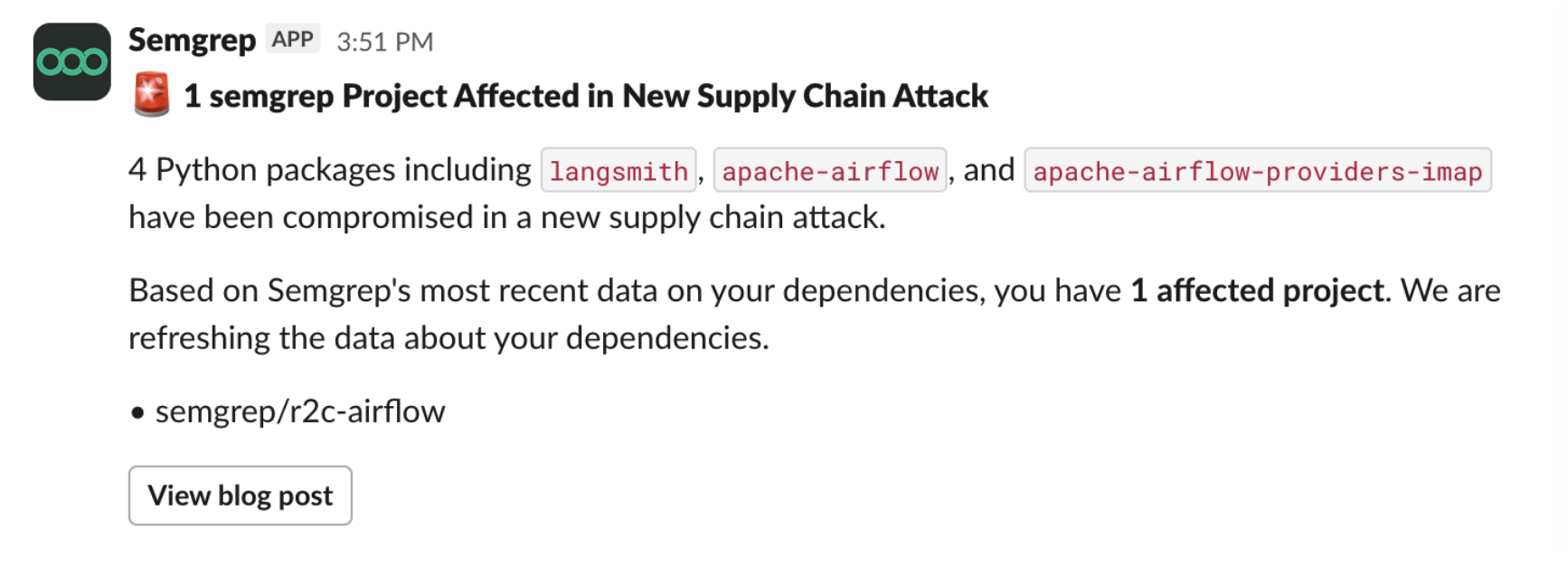 announced · Sep 2026
· source
· release history
- Adds org-wide Supply Chain policies that trigger automated responses — open a Jira ticket, send a Slack alert, or call a webhook — the moment a malware finding is generated, with no human in the loop.︀︄︇︀︅︉︀︅︀︀︃︀︀︅︅︀︅︊︀︄︆︀︃︄ announced · Sep 2026 · source · release history
- Adds confirmation step to Semgrep Registry before rules are added to a detection policy, showing the rule count, target policy, and immediate-effect warning. changelog · Sep 2026 · source · release history
- Introduces developer exception requests (public beta): admins can gate ignored findings behind an approval workflow by adding Require exception requests to any policy. changelog · Sep 2026 · source · release history
docs
- Developer exception requests are now in public beta. Admins can set developer triage permissions between no triage and full triage by adding Require exception requests to any policy. For blocking findings, an exception request must be approved before the finding is ignored and the developer is unblocked. changelog · Sep 2026 · source
example
-
Run in CI against your configured policy
semgrep ci
api
-
PUT /api/v1/deployments/{deploymentId}/policies/{policyId}· source · full API surface -
GET /api/v1/deployments/{deploymentId}/policies· source · full API surface -
GET /api/v1/deployments/{deploymentId}/policies/{policyId}· source · full API surface
Semgrep Guardian Integration shipped suggested Integrate the Semgrep Guardian service with AI coding agents to report setup status, scan summaries, and error states directly within agent turns.
Suggested capability: Static application security testing. This is our guess, not confirmed.
release 8 total
-
Adds new Semgrep Guardian authentication options: set
SEMGREP_GUARDIAN_TOKEN_COMMANDto a program that prints an OAuth token so Guardian uses it directly without opening a browser, for environments like Coder external authentication, and re-authenticate after credentials expire by running/semgrep:reconnectin… updated · seen Nov 2026 · source · release history -
Adds options to turn off Semgrep Guardian's version checks via the
SEMGREP_GUARDIAN_PHP_CHECKandSEMGREP_GUARDIAN_NODE_CHECKenvironment variables (set tooff); Guardian now checks your local PHP and Node.js versions at the start of each Claude Code and Codex session and flags versions affected by the PHP2Shell… updated · seen Nov 2026 · source · release history - Semgrep Guardian now supports PowerShell, running its hooks on both PowerShell commands and Bash commands. changelog · Oct 2026 · source · release history
- Adds PowerShell support to Semgrep Guardian, which now runs hooks on both PowerShell and Bash commands. updated · seen Oct 2026 · source · release history
- Semgrep Guardian now meets SLSA Level 3 standards, cryptographically verifying downloaded binaries are signed with a pipeline-only key and validating which commit and pipeline produced each binary. updated · seen Oct 2026 · source · release history
-
Adds
SEMGREP_GUARDIAN_AUTO_UPDATE=0environment variable andauto_update: falsekey inguardian.yamlto opt out of Semgrep Guardian's new automatic self-update behavior. updated · seen Oct 2026 · source · release history
docs
- Semgrep Guardian Semgrep Guardian now reports status in your AI coding agent. It confirms when it is set up and running, summarizes what was scanned and what was found when the agent finishes a turn, and shows sign-in requirements and server errors. changelog · Sep 2026 · source
example
-
Supply a pre-existing OAuth token from Coder external authentication so Guardian skips the browser login flow entirely.
export SEMGREP_GUARDIAN_TOKEN_COMMAND='cat /run/secrets/semgrep_token'updated · seen Nov 2026 · source -
Disable Guardian's PHP version gate in a CI environment where PHP2Shell alerts would block an automated coding session.
export SEMGREP_GUARDIAN_PHP_CHECK=offupdated · seen Nov 2026 · source -
Prevent Guardian from auto-updating its binary in environments where change control requires manual approval.
auto_update: falseupdated · seen Oct 2026 · source
Project management verified Lets users create, update, delete, and tag projects within a deployment, with confirmation warnings before bulk tag changes are applied.
Also counts toward: REST API
release
- Enables CSV export scoped to selected finding groups, with the existing 10,000-issue limit applying to the selection rather than the full filter result. updated · seen Oct 2026 · source · release history
- Deployment tag API endpoints now require tag-specific permissions; a token that previously managed projects is no longer sufficient — obtain a token with tag read permission for GET/list/find and tag write permission for update/delete. updated · seen Oct 2026 · source · release history
-
Deployment tag API endpoints now require tag-specific API permissions: use a token with tag read permission for
GET/list/find operations and tag write permission for update/delete operations. updated · seen Oct 2026 · source · release history - Semgrep now shows a confirmation warning when adding or removing project tags attached to policies, during bulk edit and from a project's settings page. updated · seen Aug 2026 · source · release history
example
-
Export only a selected subset of findings to CSV when more than 10,000 issues match your filters — select the relevant groups first, then export.
In Semgrep AppSec Platform, go to Findings, select the finding groups you want, then choose Export > CSV.updated · seen Oct 2026 · source
api 7 total
-
GET /api/v1/deployments/{deploymentSlug}/projects· source · full API surface -
DELETE /api/v1/deployments/{deploymentSlug}/projects/{projectName}/tags· source · full API surface -
GET /api/v1/deployments/{deploymentSlug}/projects/{projectName}· source · full API surface -
DELETE /api/v1/deployments/{deploymentSlug}/projects/{projectName}· source · full API surface -
PUT /api/v1/deployments/{deploymentSlug}/projects/{projectName}/tags· source · full API surface -
PATCH /api/v1/deployments/{deploymentSlug}/projects/{projectName}· source · full API surface
AI provider configuration shipped Configure connections to AI providers — including Azure OpenAI and Anthropic via Manual mode — for use by in-app features such as Autotriage and Autofix.
release 8 total
- Azure OpenAI settings now require a Base model field; new Azure OpenAI setups must supply this value. changelog · Oct 2026 · source · release history
- AI provider settings now include a required Base model field for Azure OpenAI deployments (needed for new Azure OpenAI setups), and organizations that had not chosen an AI provider mode now default to the Cloudflare Workers AI mode, while organizations that chose their own providers or are on the minimal data… changelog · Oct 2026 · source · release history
-
The
xAIAI provider is renamed toSpaceXAIand its endpoint field is removed; the provider always useshttps://api.x.ai/v1. changelog · Oct 2026 · source · release history - Connect directly to Anthropic by supplying your own Anthropic API key under the custom AI provider mode in Semgrep AppSec Platform settings, for use with in-app features (available to Semgrep Enterprise and existing bring-your-own-key users). changelog · Oct 2026 · source · release history
- Adds a Base model required field to Azure OpenAI settings, specifying the model your Azure deployment runs; new Azure OpenAI setups must populate this field. updated · seen Oct 2026 · source · release history
- New Azure OpenAI setups require a Base model field to be filled in before the connection can be configured. updated · seen Oct 2026 · source · release history
Supply chain incident notifications shipped Notifies teams of active supply chain incidents via a default notification policy, with optional Slack alerts targeted based on the most recent SBOM.
Also counts toward: Outbound webhooks (the product notifies you)
release
- Slack notifications now use one layout covering Semgrep Agentic Workflows issues, Semgrep Code, Semgrep Supply Chain, Semgrep Secrets findings, incoming webhook findings, and triage events. updated · seen Nov 2026 · source · release history
-
Expands Semgrep Supply Chain dependency inventory and SBOM to include every package declared in a Python
requirements.txtfile, not only packages pinned with==. updated · seen Oct 2026 · source · release history - Surfaces active or recent Supply Chain incidents at the top of the Advisories page, with advisory Details pages linking to related incidents, dependencies, and blog posts. changelog · Oct 2026 · source · release history
-
Adds early-notification opt-in that proactively informs customers via Slack or webhooks of their blast radius — affected repos, projects, findings, and scan progress — when a new supply chain incident is detected.
announced · Sep 2026
· source
· release history
-
Adds
webhookas a supported action on the Early notification for Supply Chain incidents policy, alongside Slack. changelog · Sep 2026 · source · release history - A default Supply Chain incident notification policy is now available to all Supply Chain customers using Unified policies, with optional Slack channel notifications for ongoing incidents based on the most recent SBOM. updated · seen Aug 2026 · source · release history
example
-
Add a webhook action to the Early notification for Supply Chain incidents policy so your security team is notified of new incidents in real time.
In the Semgrep console, go to Policies > Early notification for Supply Chain incidents > Actions, click 'Add action', select 'Webhook', and enter your webhook URL.changelog · Sep 2026 · source
Autofix pull request tracking shipped suggested Expose per-finding data on Autofix-generated pull requests and failed Autofix attempts across all Code and AI-powered detection findings in a deployment.
Suggested capability: Static application security testing. This is our guess, not confirmed.
release
-
Adds experimental
GET /api/deployments/{deployment_id}/issues/{issue_id}/related-issuesendpoint that returns a finding's related issues; the existingrelatedIssuesfield on finding responses is now deprecated.︀︄︇︀︅︉︀︅︀︀︃︀︀︅︅︀︅︊︀︄︆︀︃︄ updated · seen Oct 2026 · source · release history -
The
relatedIssuesfield on finding responses is deprecated; useGET /api/deployments/{deployment_id}/issues/{issue_id}/related-issuesinstead. updated · seen Oct 2026 · source · release history -
The
GET /api/v1/deployments/{deploymentSlug}/findingsendpoint now returnsclick_to_fix_prs(pull requests created by Autofix) andclick_to_fix_failures(failed Autofix attempts) on all Semgrep Code and AI-powered detection findings for every deployment, not only Autofix-beta… updated · seen Oct 2026 · source · release history
example
-
Fetch related issues for a specific finding to surface correlated alerts without relying on the deprecated
relatedIssuesfield in the finding response.curl -s -H 'Authorization: Bearer <token>' \ 'https://semgrep.dev/api/deployments/<deployment_id>/issues/<issue_id>/related-issues'updated · seen Oct 2026 · source -
Retrieve Autofix PR and failure details for every finding in a deployment — useful for auditing which findings have pending fix PRs or repeated Autofix failures.
curl -H 'Authorization: Bearer <token>' 'https://semgrep.dev/api/v1/deployments/<deploymentSlug>/findings' | jq '.findings[] | {id, click_to_fix_prs, click_to_fix_failures}'changelog · Oct 2026 · source -
Pull Autofix PR and failure data for all findings in a deployment to audit which issues have been auto-remediated and which attempts failed.
curl -H 'Authorization: Bearer <token>' 'https://semgrep.dev/api/v1/deployments/<deploymentSlug>/findings' | jq '[.findings[] | {id: .id, fix_prs: .click_to_fix_prs, fix_failures:…updated · seen Oct 2026 · source
Dependency filtering and inventory shipped Filter dependencies by version directly on the Dependencies page using exact or contains-matching modes, and enumerate all declared Python requirements including version ranges and unpinned packages in the dependency inventory and SBOM.
release
-
Python packages declared with a version range or without a version in
requirements.txtnow show the declared range (marked with an unpinned icon) in the Version column on the Dependencies page, and SBOM exports list them as CycloneDX components without a version, with the declared range included as a component… updated · seen Nov 2026 · source · release history -
Supply chain dependency analysis now supports Bun projects that use a
bun.locklockfile with apackage.jsonfile, including direct and transitive dependencies and workspaces; the binarybun.lockbformat is not supported — switch withbun install --save-text-lockfile --frozen-lockfile --lockfile-onlythen… updated · seen Nov 2026 · source · release history - Filter dependencies by version directly on the Dependencies page without opening advanced options; the dependency filter is now an All dependencies menu with Exact and Contains matching modes and All versions or Select versions options. changelog · Oct 2026 · source · release history
-
Semgrep Supply Chain now includes every package declared in a Python
requirements.txtfile — including packages with version ranges (e.g.requests>=2.0) and packages without a version (e.g.flask) — in the dependency inventory and SBOM, not only packages pinned with==. changelog · Oct 2026 · source · release history
example
-
Switch a Bun project from the unsupported binary lockfile to the text lockfile format so Semgrep Supply Chain can analyse its dependencies.
bun install --save-text-lockfile --frozen-lockfile --lockfile-only && rm bun.lockbupdated · seen Nov 2026 · source
Autonomous Autofix for Supply Chain shipped Enable Supply Chain Autofix to open pull requests independently of Upgrade Guidance, without requiring the guidance step to have run first.
release
- Supply Chain Autofix now opens pull requests for transitive dependencies in npm and PyPI projects that have a lockfile. updated · seen Nov 2026 · source · release history
- Read-only API tokens can now call the v1 Supply Chain dependency and SBOM export endpoints, which previously required an admin-only scope. updated · seen Oct 2026 · source · release history
- Adds AWS CodeArtifact support (private beta) for connecting private Maven or Gradle registries so Dynamic Dependency Resolution can resolve packages during Managed Scans using IAM role assumption instead of stored AWS keys. updated · seen Oct 2026 · source · release history
- Makes Supply Chain Autofix independent of Upgrade Guidance, allowing Autofix pull requests to be opened even when Upgrade Guidance is disabled or has not yet run. changelog · Sep 2026 · source · release history
- Supply Chain Autofix is now independent of Upgrade Guidance — pull requests can be opened even when Upgrade Guidance is disabled or has not run. updated · seen Sep 2026 · source · release history
Findings dashboard shipped suggested View and filter findings across a deployment in charts, drilldowns, and PDF exports, including a Finding type filter to distinguish AI-powered from rule-based findings.
Suggested capability: Static application security testing. This is our guess, not confirmed.
release
-
Query a finding's related issues with the new experimental endpoint
GET /api/deployments/{deployment_id}/issues/{issue_id}/related-issues; the existingrelatedIssuesfield on finding responses is now deprecated.︀︄︇︀︅︉︀︅︀︀︃︀︀︅︅︀︅︊︀︄︆︀︃︄ changelog · Oct 2026 · source · release history - Add a Finding type filter to dashboards to view AI-powered and Rule-based findings separately in charts, drilldowns, and PDF exports. changelog · Oct 2026 · source · release history
- Adds a Finding type filter to dashboards, enabling separate views of AI-powered and Rule-based Semgrep Code findings in charts, drilldowns, and PDF exports. updated · seen Oct 2026 · source · release history
example
-
Retrieve all related issues for a specific finding to triage clusters of related vulnerabilities at once.
curl -H 'Authorization: Bearer <token>' 'https://semgrep.dev/api/deployments/<deployment_id>/issues/<issue_id>/related-issues'changelog · Oct 2026 · source
SCIM user and group provisioning shipped Sync users and groups from Okta or Microsoft Entra ID via SCIM so that deployment roles and team membership are assigned automatically.
release
-
Adds SCIM provisioning at
Settings > Access > Login methodsto sync users and groups from Okta and Microsoft Entra ID, with groups able to assign deployment roles and manage Semgrep teams (Teams feature in beta); available for default-tenant deployments with SSO configured.︀︄︇︀︅︉︀︅︀︀︃︀︀︅︅︀︅︊︀︄︆︀︃︄ updated · seen Oct 2026 · source · release history
docs
- SCIM provisioning is now in public beta. Set up SCIM at Settings > Access > Login methods to provision users and groups from your identity provider, including Okta and Microsoft Entra ID. Groups can assign deployment roles and, with Teams (beta) , manage Semgrep teams. changelog · Oct 2026 · source
example
-
Set up SCIM to automatically provision users and groups from Okta or Microsoft Entra ID into your Semgrep organization.
In Semgrep, go to Settings > Access > Login methods, then enable SCIM provisioning and copy the SCIM base URL and token into your identity provider (Okta or Microsoft Entra ID).changelog · Oct 2026 · source -
Provision users and groups from Okta or Microsoft Entra ID into Semgrep to automate team membership and deployment-role assignment.
In the Semgrep console, go to Settings > Access > Login methods and follow the SCIM provisioning setup flow for your identity provider (Okta or Microsoft Entra ID).changelog · Oct 2026 · source
License compliance shipped Allows teams to block dependencies based on their licenses, including a mode that only blocks when every detected license is disallowed.
release
-
Removed endpoint GET
/api/v1/bootstrap-sms-vpc 1.0.0 · Sep 2026 · source · release history -
Removed endpoint GET
/api/v1/ping 1.0.0 · Sep 2026 · source · release history - Supply Chain now runs license checks during diff scans even when no dependency source file (lockfile or manifest) changed in the merge request — requires Semgrep CLI 1.174.0 or later. updated · seen Aug 2026 · source · release history
- License compliance can now be configured to block a dependency only when all of its licenses are blocked, rather than when any single license is blocked. updated · seen Aug 2026 · source · release history
Billing and product selection shipped Select and purchase any combination of products directly from the Settings billing page.
Also counts toward: Web management console
release
-
Redesigns
Settings > Billingto allow selecting and purchasing any combination of products. updated · seen Oct 2026 · source · release history - Enables Autofix for all customers; it remains opt-in per finding and runs only when requested from the finding page or through the API. changelog · Sep 2026 · source · release history
- Autofix is now enabled for all customers; it remains opt-in per finding, triggered from the finding Details page or through the API.︀︄︇︀︅︉︀︅︀︀︃︀︀︅︅︀︅︊︀︄︆︀︃︄ updated · seen Sep 2026 · source · release history
- Splits Usage and Billing into separate tabs in Semgrep AppSec Platform Settings, with credit usage visible to all users and self-serve product purchasing available. changelog · Sep 2026 · source · release history
Autonomous Autofix for Code shipped suggested Remove the global toggle for Code Autofix, making it available to all customers as an opt-in action triggered per finding or via API.
Suggested capability: Static application security testing. This is our guess, not confirmed.
release
- Running AI analysis or opening an Autofix pull request now requires triage permission; read-only users receive an explanatory error. updated · seen Oct 2026 · source · release history
- Removes the Code Autofix toggle from Settings; Supply Chain retains its own separate toggle for Upgrade Guidance and Supply Chain Autofix. changelog · Aug 2026 · source · release history
- The Code Autofix toggle has been removed from Settings. Supply Chain retains its own toggle for Upgrade Guidance and Supply Chain Autofix. changelog · Aug 2026 · source · release history
- The Code Autofix toggle has been removed from Settings; Supply Chain retains its own separate toggles for Upgrade Guidance and Supply Chain Autofix. updated · seen Aug 2026 · source · release history
API rate limiting shipped Enforce rate limits on public deployment API endpoints, returning HTTP 429 when repeated or concurrent requests exceed the allowed threshold.
Also counts toward: REST API
release
-
Rate limits for
/api/v2/deployments/public/{id}and/api/v2/deployments/public/searchnow count every request including repeated and concurrent requests. changelog · Oct 2026 · source · release history -
The public deployment endpoints
/api/v2/deployments/public/{id}and/api/v2/deployments/public/searchnow count every request (including repeated and concurrent ones) against rate limits, returning HTTP 429 when exceeded. updated · seen Oct 2026 · source · release history
Zero-day Incident Detection shipped Detect zero-day supply chain incidents by rescanning repositories with AI-assisted, expert-verified advisory rules and organizing findings by incident.
release
- Adds Language, Severity, and Advisory type filters to the Supply Chain Advisories page, with an Incident column added to the advisories table. updated · seen Oct 2026 · source · release history
-
Adds zero-day incident detection that rescans all customer repositories with AI-assisted, expert-verified advisory rules within minutes of a supply chain incident and posts findings to the Semgrep dashboard organized by advisories rolled up into incidents.
announced · Sep 2026
· source
· release history
Unified policies shipped Provides a unified policy system that consolidates scan, triage, and notification policies into one place, with a migration path from the older policy experience.
release
- Unified policies migration banner now displays the migration schedule: migrations begin August 24, 2026, with the current Policies version sunsetting November 1, 2026. updated · seen Aug 2026 · source · release history
- A default Supply Chain incident notification policy is now available to all Supply Chain customers using Unified policies, with optional Slack channel notifications for ongoing incidents based on the most recent SBOM. updated · seen Aug 2026 · source · release history
Advisory filtering shipped Filter advisories by language, severity, and advisory type on the Advisories page, and view an incident column in the advisories table.
release
- Filter advisories by Language, Severity, and Advisory type on the Advisories page, using the same filters available on the Findings page; the advisories table also gains an Incident column. changelog · Oct 2026 · source · release history
GitHub App webhook management shipped Rotate GitHub App webhook secrets to restore pull request scan triggering after a secret becomes stale.
example
-
Rotate a stale GitHub App webhook secret so that pull request scans resume triggering after secret rotation.
In Semgrep AppSec Platform, go to Settings > Source code managers, find your GitHub App connection, and click 'Rotate webhook secret'.changelog · Oct 2026 · source
Workflow scheduling and credit tracking shipped Schedule agentic workflow runs and track total credits consumed across all trigger types, including pull-request-initiated runs.
release
- The Total credits used column on the workflow scheduling page now counts runs from every trigger, including pull-request-initiated runs, not only scheduled runs. changelog · Oct 2026 · source · release history
Malware Firewall shipped Intercept and block malicious dependency requests at the network level between package managers and public registries.
release
-
Adds a Malware Firewall (private beta), embedded in Semgrep Guardian via Agent admin, that intercepts dependency requests at the network level between the package manager and public registries and blocks malicious packages before they reach developer machines, with no per-device install.
announced · Sep 2026
· source
· release history
Third-party integration repository support shipped Extend integrations such as Wiz to receive and process findings from additional repository sources beyond GitHub, including Azure DevOps and Bitbucket Data Center.
release
- The Wiz integration now accepts findings from Azure DevOps and Bitbucket Data Center repositories, in addition to GitHub. updated · seen Nov 2026 · source · release history
Lines in monospace are the tool's own words: help text
parsed from its source, or an endpoint from its API document. Under
release, a line is our summary of a dated release. Under
docs, it is quoted from the tool's own documentation or
website. Each links back to the source it came from.
Command line
11 commands for Semgrep, each with where it came from. This tool has no source analysis yet, so there is no option reference and no captured run beside them.
No command matches.
Screenshots
From the release notes, newest first. Click one to see it full size.Score card
-
Shipping velocity releases a month, last 12 months
-
Documentation quality release-notes rubric, 0–100
-
Breaking-change discipline how rarely a release breaks users, and notice given
-
Maintenance risk quiet time against its own cadence, maintainers
-
Innovation & surface new capabilities, API and MCP surface
Five scores for Semgrep, each built from the releases, notes and API history this site tracks — and, on Researcher and Business, where it stands among every measured tool in its category and how that has moved.
Score cards are part of every paid plan.
See plans → Already subscribed? Sign in →Trajectory
Blank means never measured; nothing here is a filled-in zero.
Peer standings are included with Researcher and Business. See how this tool ranks against its competitors, using data we don't publish anywhere else.
See plans →Each score is 0–100 on a published rubric, derived from data this site already shows. A dimension we cannot measure says so — it is never scored 0 and never enters a rank.
How this is scored
- Shipping velocity — releases a month over the last 12 months, on a log scale where 16 a month scores 100. Needs 3 releases in the window.
- Documentation quality — the release-notes rubric published on the analytics page, unchanged.
- Breaking-change discipline — the share of releases carrying a breaking change (none scores 100, half or more scores 0). Only projects that label breaking changes are measured: a clean record cannot be told from an unlabelled one.
- Maintenance risk — quiet time measured against the tool's own release cadence (quiet longer than 90 days and three typical gaps scores 0), plus the number of active maintainers and whether contributors are growing, where known. Higher is lower risk.
- Innovation & surface — new capabilities in the feature ledger this year, API and MCP operations added, and the share of commits that are features: the mean of whichever we hold.
- Community health (open-source tools only) — each is a direction, not a size: contributors this year against last, the bus factor now against a year ago, and issues closed per issue opened, where steady scores 50, doubled 100 and halved 0; plus the median time to a maintainer's first reply (an hour scores about 100, a month or more 0). A commercial card has no repository and carries none of the four.
- Documented delivery (commercial tools) — when a vendor's documented new capabilities have slowed against its own baseline, that counts against the overall standing as heavily as two low dimensions. Steady delivery, or too little history to judge, leaves the standing alone; it is never a sixth score.
- Open-source tools are scored on repository signals; commercial tools on their published changelog. Ranks compare tools within one category and one profile and need at least five measured peers; the overall standing needs three ranked dimensions. Best-in-breed or consolidator is a shape, not a quality, and is never scored.
Release-note detail over time
See how much detail Semgrep puts in its release notes, quarter by quarter, and compare it with tracked tools in the same category. This history uses up to ten retained, reviewed notes per tool; sparse or blank older quarters may reflect that limit.
Checking release-note history…
Commercials
pricing & packaging history · Semgrep vendor page36 readings of Semgrep's pricing page since Oct 2021, with 11 relaunches of its plan lineup and 9 changes to what its plans include — each one dated, compared with the reading before it, and explained for someone buying the tool.
Pricing and packaging history is included with Researcher and Business. See how every vendor we track sells, and how that has changed over time, using data we don't publish anywhere else.
See plans → Already subscribed? Sign in →Plans by offering
Each offering on the pricing page links to its own page of plans, read at its latest capture.
Plan relaunches
Plans, prices and descriptions are quoted from the vendor's own pricing page as we read it on each date. A plan missing from a later reading is shown as no longer listed on the page — a statement about the page, not the product. Readings that failed to show any plans are left out rather than read as a change.
Website history
semgrep.dev, every changeSemgrep's home and pricing pages and 33 more pages as they looked each month from October 2021 to October 2026: 59 renders, 8 changes of tagline or palette. Step through them, play them, or put any two months side by side.
Website history is included with Researcher and Business.
See plans → Already subscribed? Sign in →← → or h l a month · Shift a year · [ ] previous / next change · Space play · 1 2 3 page · T whole page · C compare · F full size
← → or h l the right month · Shift the left · S swap · W wipe · T whole page · Esc back
Rebranding timeline
Dates bound when a change appeared between captures. Possible rebrands are AI suggestions; a redesign alone does not establish a rebrand.
Coverage
Missing something? Tell us
What Semgrep connects to, runs on and detects, read from its release notes and docs. So far: 3 new integrations, 2 new supported platforms.
5 changes, tracked since Oct 5, 2026.
-
Oct 172026
new APEX language support
C and C++ • C# • Elixir • Generic • Go • Java • JavaScript • JSON • Kotlin • Python • TypeScript • Ruby • Rust • JSX • PHP • Scala • Swift • Terraform APEX
-
Seen Oct 102026
new Cursor Origin SCM integration
Cursor Origin support is … Semgrep, sync repositories, run Managed Scans , and see scan checks and finding comments directly in Cursor pull requests.
-
Seen Oct 102026
new AWS CodeArtifact registry support (private beta)
With Maven, Gradle
AWS CodeArtifact support is now in private beta . You can connect … private Maven or Gradle registry so Dynamic Dependency Resolution can resolve packages during Managed … . Semgrep assumes an IAM role in your AWS account instead of storing AWS keys.
-
Seen Oct 102026
new Network Broker scms field for private SCM instances
With GitHub, GitLab, Bitbucket, Azure DevOps
Added … scms configuration field to … source code manager instances of … type (GitHub, GitLab, Bitbucket, or Azure DevOps) … keep those instances off the public internet can list each instance in scms instead of maintaining a long custom allowlist per instance
-
Oct 52026
new SCIM provisioning with Okta and Microsoft Entra ID
Set up SCIM at Settings > Access > Login methods to provision users and groups from your identity provider, including Okta and Microsoft Entra ID.
Editors & IDEs 1
Identity & access 2
Source control & CI/CD 2
Languages & runtimes 1
Source control & CI/CD 4
Languages & runtimes 1
Nothing first seen in this window. That doesn't mean Semgrep shipped nothing, only that we found no record of it.
How we count
Read from 7 of 35 release notes and docs updates we hold for Semgrep. "First seen" is the earliest note that names something; "last" is the latest. Our history may start partway through Semgrep's life, so an old integration can show a recent first-seen date.
Each change counts once: "added 40 checks" is one line, so the numbers measure how often coverage moves, not how big the catalogue is or how well it detects.
Releases
35 entries
No entries match these filters.
- November 20261
- October 202611
- September 202614
- August 20269
Add the badge to your README
Maintain this project? The badge links readers straight to this page, so they can follow every release here.
 Choose a badge style and copy the code →